

Master Brazilian Portuguese for Business
Unlock new markets. Communicate with confidence. Thrive in the global economy.
Professional Portuguese language training tailored for business professionals, executives, and entrepreneurs.

Meet the Tutor

Iara Leão is originally from Belo Horizonte, the capital city of the state of Minas Gerais (known for its food and coffee) in Brazil.
She began teaching Brazilian Portuguese back in 2009 in the United States while she was doing her Master’s degree. Since then, Iara has had the opportunity to teach a wide range of students, always accomodating their needs and goals in learning the language.
In 2020, Iara published a book entitled ‘Doing Business in Brazil: a guide to the language and the culture’. In this book, she introduces the basic knowledge of the Brazilian Portuguese language and also presents facts about the Brazilian culture that should help readers to communicate and to understand Brazilians in verbal and non-verbal ways.
Her approach to teaching is to get students to feel comfortable to speak the language. Students are encouraged to participate in class and are shown that it is perfectly normal to make a mistake while speaking a foreign language, and that that should never be a reason to make someone scared of learning.
Iara believes in enjoying learning the language and having fun doing so!
Doing Business in Brazil: A guide to the language and culture
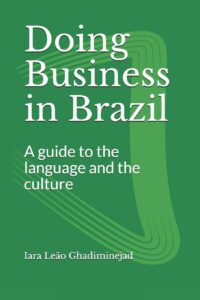
This book was written to be your helpful guide to understanding the basic concepts of the Portuguese language, as well as Brazilian culture. Whatever may be the reason that is motivating you to learn a new language – a short vacation, business opportunities, friends and/or partner, or simply a hobby – learning about the culture of a country is also very important. Learning about it might help you to blend in, to understand and to be understood, and to avoid doing or saying something that might come across as offensive. When it comes to learning Brazilian Portuguese, it is the same principle. You are not only learning Portuguese, you are learning the variation of the language spoken in Brazil and the cultural aspects that might help you understand the language, the people and their habits more clearly.